How Does A Toaster Work: Simple Explanation
Introduction
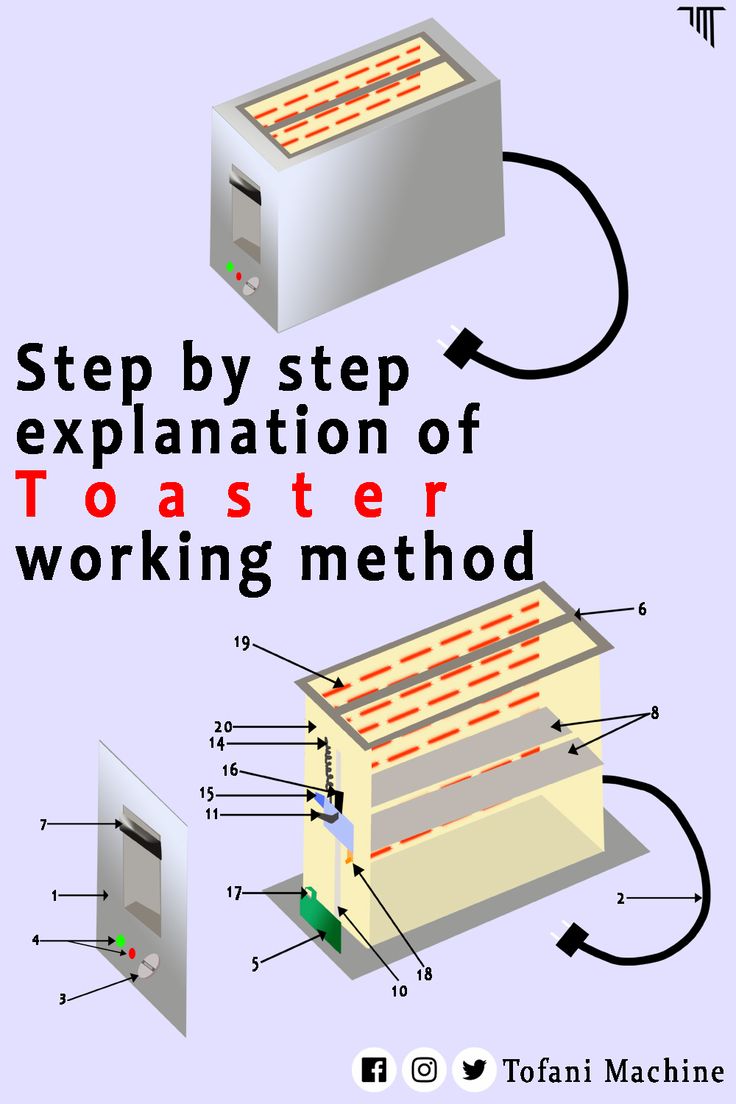
A toaster turns electrical energy into heat. In a typical U.S. pop-up toaster, electricity flows through thin resistance wires called nichrome heating elements. These wires become very hot and glow red. Their heat browns the bread, while a timer or electronic control stops the cycle and releases the toast.
Most household toasters in the United States run from a 120-volt outlet. Their basic design has changed little: a spring-loaded bread carriage, heating elements, a control system, and a safety release work together inside a small appliance.

How a Toaster Works in One Sentence
A toaster sends electric current through high-resistance wires, changes that energy into heat, directs the heat at the bread, and ends the cycle after a set time or temperature.
The process has four main stages:
- You press down the lever.
- The toaster locks the carriage in place and powers the heating elements.
- Radiant heat dries and browns the bread.
- A timer or heat sensor cuts power and releases the carriage.
This simple sequence explains why a toaster can heat bread quickly without using a pan or flame.
The Main Parts of a Toaster
Each part has a specific job. Together, these parts control heat, timing, movement, and safety.
Heating elements
Heating elements are thin wires made from a resistance alloy, often nichrome. Nichrome contains nickel and chromium. It works well because it has:
- High electrical resistance
- A high melting point
- Good resistance to oxidation
- Stable performance at high temperatures
When current passes through the wire, the wire resists that flow. The electrical energy becomes heat. At high temperatures, the wire also gives off infrared radiation, which helps brown the bread.
Many toasters place heating elements on both sides of each bread slot. A metal frame or mica support holds the elements in position and helps prevent contact with the bread.
Bread carriage and lever
The carriage holds the bread and moves it between the cool loading position and the hot toasting position.
When you push down the lever:
- The bread moves into the slot.
- Springs are compressed.
- The carriage reaches its lower position.
- An electrical switch closes.
- A latch holds the lever down.
When the cycle ends, the latch releases. The springs then push the carriage and toast upward.
Electromagnet or electronic latch
Many traditional pop-up toasters use an electromagnet. When the toaster receives power, the electromagnet holds a metal piece connected to the lever.
When the control circuit removes power, the magnet loses its force. The carriage is released and pops up.
Some newer toasters use electronic controls and a motor or electronic release system instead. The exact design varies by model, but the goal is the same: hold the carriage during heating and release it at the end.
Timer and browning control
The browning dial does not always set an exact temperature. In many models, it changes how long the heating elements stay on.
A higher setting usually means a longer heating period. Some advanced models also adjust the heating pattern or use sensors, but time remains a major factor in most basic toasters.
Control board
Digital or feature-rich toasters may contain a small control board. It can manage:
- Heating time
- countdown displays
- Defrost settings
- Reheat settings
- Bagel mode
- One-sided heating
- Automatic shutoff
- Error detection
A basic toaster may use a mechanical timer or bimetal thermostat instead of a digital board.
Crumb tray
The crumb tray catches loose bread particles. It helps keep crumbs away from the heating elements and makes cleaning easier.
A full or dirty crumb tray can allow crumbs to burn. In some cases, accumulated crumbs can create smoke or a fire hazard.

What Happens When You Push the Lever Down?
The lever starts both a mechanical and an electrical process.
-
The carriage moves down.
The bread enters the slot between the heating elements. -
A switch closes.
This allows electricity to reach the control circuit and heating elements. -
The latch engages.
An electromagnet or electronic mechanism holds the carriage down. -
The elements heat up.
Current flows through the nichrome wires, producing heat and infrared radiation. -
The control system counts the cycle.
A timer, sensor, or control board tracks the toasting period. -
The power stops.
The elements cool, the latch releases, and the springs lift the bread.
If the toaster has no power, the lever may not stay down. This is often normal. Many pop-up toasters use the energized electromagnet as part of the holding system.
How Does a Toaster Brown Bread?
A toaster browns bread through heat-driven chemical reactions. The main reaction is the Maillard reaction, which occurs when heat changes sugars and amino acids on the surface of food.
Caramelization can also occur as sugars break down under heat. These reactions create the brown color and roasted flavor associated with toast.
Bread does not brown only because it gets hot. Its surface must also lose enough moisture. Water in the bread absorbs energy as it turns into steam. Once the surface becomes drier and hotter, browning speeds up.
This is why:
- Dry bread often browns faster.
- Thick bread may need more time.
- Frozen bread needs extra heat or a defrost cycle.
- Moist or dense bread may stay pale in the center.
- Sugary bread can brown or burn quickly.
A toaster mainly transfers heat by infrared radiation from the glowing elements. Hot air also moves through the slots and contributes to the process.

Why Does One Side of the Toast Sometimes Brown More?
Uneven toast usually results from uneven heat, bread position, or moisture.
Common causes include:
- A heating element that is partly damaged
- Bread that sits closer to one side
- A slice that is too wide or irregular
- Crumbs blocking part of the element
- Different moisture levels across the bread
- A faulty control circuit
- A toaster designed to heat one side in bagel mode
Turn the bread around only when the toaster is off and the carriage is fully raised. Never reach into a working toaster with a knife, fork, or other metal object.
If one side stays cold across several cycles, stop using the toaster. A damaged heating element or control may require professional repair or replacement.
What Do the Browning Settings Really Mean?
The browning dial usually controls the length of the heating cycle. It does not guarantee a precise toast color.
| Setting choice | Typical result | Factors that can change it |
|---|---|---|
| Low | Light toast | Dry bread may still brown quickly |
| Medium | Moderate browning | Bread type and slice thickness matter |
| High | Dark toast | Sugary bread may burn before the cycle ends |
The same setting can produce different results because bread varies in:
- Thickness
- Moisture
- Sugar content
- Density
- Frozen or thawed condition
- Surface area
For consistent results, use bread slices of similar thickness and begin with a medium setting. Adjust the setting based on the first cycle rather than assuming every bread type needs the same time.
How Defrost, Reheat, and Bagel Modes Work
Extra settings change the timing or heating pattern.
Defrost mode
Defrost mode usually adds time. The toaster first warms the frozen bread and then continues with the browning cycle.
It does not turn the bread into fresh bread. It simply accounts for the extra energy needed to thaw it.
Reheat mode
Reheat mode uses a shorter cycle with little or no added browning. It warms toast that has cooled without starting a full browning cycle.
The exact behavior depends on the toaster.
Bagel mode
Bagel mode often heats the cut side more strongly while reducing heat on the outside crust. This keeps the crust from becoming too dark while toasting the cut surface.
Place the bagel according to the markings on the toaster. Incorrect placement can lead to poor results or excess browning.

How Much Electricity Does a Toaster Use?
A toaster uses a high amount of power for a short time. Many household models are rated somewhere around 800 to 1,500 watts, but the exact value is printed on the appliance label or manual.
You can estimate energy use with this formula:
Energy used in kilowatt-hours = power in kilowatts × time in hours
Example calculation
Suppose a toaster uses 1,200 watts and runs for 3 minutes.
- 1,200 watts = 1.2 kilowatts
- 3 minutes = 0.05 hours
- 1.2 × 0.05 = 0.06 kilowatt-hours
So, one 3-minute cycle would use about 0.06 kilowatt-hours under those conditions.
Your electricity cost depends on the rate charged by your utility. To estimate cost:
Cost = kilowatt-hours used × electricity price per kilowatt-hour
The toaster’s wattage label gives a better estimate than a general online figure because models differ.
Why Does a Toaster Get Hot on the Outside?
Some heat escapes from the slots, vents, and metal housing. The toaster body may also absorb heat from the heating elements.
A toaster can feel warm during normal operation. However, the housing should not become unusually hot, melt, smoke, spark, or smell like burning plastic.
Stop using the toaster and unplug it if you notice:
- Smoke that does not come from crumbs
- Sparks
- A burning electrical smell
- A damaged cord or plug
- A hot spot on the casing
- A lever that sticks or fails to release
- Repeated tripped breakers
Do not touch a damaged toaster while it is energized. Disconnect power first if you can do so safely.
Why Does a Toaster Pop Up?
The pop-up action comes from springs in the bread carriage.
During loading, pushing down the lever compresses these springs. The latch holds the carriage down while the toaster operates. At the end of the cycle, the latch releases, and the springs push the carriage upward.
The toast rises with the carriage. This design lets you remove the bread without touching the hot slot or heating elements.
If the carriage does not pop up, unplug the toaster. Do not pull the bread out with a metal utensil. A stuck carriage may result from crumbs, a damaged spring, a failed latch, or an electrical fault.

Toaster Troubleshooting: Symptoms and Safe Checks
Troubleshoot a toaster from the outside first. Do not open the housing while it is plugged in.
| Symptom | Possible cause | Safe next step |
|---|---|---|
| Lever will not stay down | No power, failed latch, or control fault | Check the outlet and plug; unplug the toaster if it still fails |
| Bread does not heat | Failed element, switch, or control | Stop using the toaster |
| One side stays pale | Damaged element or uneven placement | Try another slice once; replace or service the toaster if the issue continues |
| Toast burns quickly | Setting too high, dry bread, or control fault | Lower the setting; stop use if the timing seems abnormal |
| Toaster smokes | Crumbs, food residue, or electrical failure | Unplug it and let it cool; clean only as directed |
| Carriage sticks | Crumbs or mechanical damage | Unplug it; do not force the lever |
| Plug or cord gets hot | Poor connection, damaged cord, or overload | Unplug it and discontinue use |
| Breaker trips | Short circuit or overloaded circuit | Do not reset repeatedly; have the appliance checked or replaced |
A toaster that repeatedly fails should not be treated as a minor inconvenience. It is a high-power heating appliance, and continued use can increase fire or shock risk.
How to Clean a Toaster Safely
Clean the toaster only after it is unplugged and fully cool.
- Unplug the toaster from the outlet.
- Move it over a sink or trash can.
- Remove and empty the crumb tray.
- Wash the tray if the manual allows it.
- Let the tray dry fully before replacing it.
- Turn the toaster upside down and gently shake out loose crumbs.
- Wipe the outside with a slightly damp cloth.
- Dry the exterior before plugging it in again.
Do not pour water into the toaster. Do not submerge it. Do not insert a knife, fork, spoon, or other metal tool into the slots.
Do not use compressed air unless the manufacturer specifically permits it. Air pressure may push crumbs deeper into the appliance or spread debris onto electrical parts.

Toaster Safety: What You Should Never Do
A toaster combines electricity with high heat, so safe use matters.
- Do not insert metal objects into the slots.
- Do not use the toaster near water.
- Do not cover the slots while it operates.
- Do not place the toaster under cabinets if heat cannot escape.
- Do not leave a malfunctioning toaster plugged in.
- Do not operate it with a damaged cord or plug.
- Do not force oversized food into the slots.
- Do not toast food with loose fillings that can drip into the appliance.
- Do not use a toaster for foods the manual does not approve.
- Do not leave children unsupervised near a working toaster.
Keep the toaster on a stable, heat-resistant surface. Allow air to move around it. If food becomes stuck, unplug the toaster and let it cool before removing the food.
If a fire starts inside the toaster, disconnect power only if you can do so without touching flames or creating danger. Do not use water on an energized electrical appliance. Leave the area and contact emergency services if the fire does not stop immediately or spreads.
Can You Repair a Toaster?
Some faults are simple, such as a full crumb tray or a dirty exterior. Internal faults are different.
A toaster contains live electrical parts, hot surfaces, springs, and control components. Unplugging it does not make every internal component safe to handle immediately, and opening the housing can create shock, fire, or mechanical risks.
Replace the toaster or use a qualified appliance repair professional when it has:
- A damaged power cord
- Burn marks
- Melted plastic
- Repeated electrical faults
- A failed heating element
- A stuck carriage
- A burning odor
- A cracked plug
- Water damage
For a low-cost toaster, replacement may be more practical than repair. That choice should not override safety. Do not continue using an appliance simply because it still produces heat.

Common Misconceptions About Toasters
A higher browning number always means higher heat
Not necessarily. Many controls extend the heating time rather than raising the element temperature.
The toaster cooks bread from the inside out
A toaster mainly heats the outer surfaces first. Heat then moves inward through the bread.
A toaster uses very little electricity
It runs for a short time, but its wattage can be high. Its total energy use is often modest because the cycle is brief.
A toaster can safely toast anything that fits
Size is not the only concern. Food can drip, melt, burn, or block the mechanism. Follow the instructions for the model.
Shaking a toaster while it is plugged in is safe
It is safer to unplug it first. Movement can disturb crumbs, expose hot parts, or cause contact with electrical components.
Frequently Asked Questions
How hot do toaster heating elements get?
They become hot enough to glow red and produce strong infrared radiation. The exact temperature varies by design and operating cycle, so a single number does not apply to every toaster.
Why does my toaster not work unless I hold the lever down?
Many toasters use an electromagnet or electronic latch that needs power to hold the lever. If the lever will not stay down, check the outlet once. If power is available, the toaster may have a failed latch or control circuit.
Can I toast frozen bread?
Many toasters include a defrost setting for frozen bread. Use the setting and bread size approved by the manual. Watch the first cycle because frozen bread can toast unevenly.
Why does toast sometimes catch fire?
Burned crumbs, long heating cycles, trapped food, or a faulty toaster can create a fire risk. Unplug the toaster, clean the crumb tray when it is cool, and stop using it if smoke or unusual heat continues.
Is a toaster more efficient than an oven for one slice of bread?
For a single slice, a toaster usually heats only a small space and runs for a short period. That can use less energy than heating a full oven, but the exact difference depends on the toaster, oven, cycle length, and electricity source.
Key Takeaways
- A toaster changes electrical energy into heat through resistance wires.
- Nichrome heating elements produce both radiant heat and hot air.
- A carriage, latch, timer, and springs control the toast cycle.
- Browning depends on time, heat, moisture, bread type, and slice thickness.
- The browning dial often changes heating time rather than exact temperature.
- Unplug the toaster before cleaning or removing stuck food.
- Never insert metal tools into a toaster.
- Replace or professionally service a toaster that sparks, smokes, smells of burning, or has a damaged cord.
Conclusion
A toaster works by sending current through high-resistance heating elements. Those elements become hot, transfer heat to the bread, and trigger browning as the bread surface dries.
The lever, latch, timer, control system, springs, and crumb tray make the process automatic. Clean the appliance when it is unplugged, keep metal objects away from the slots, and stop using the toaster when it shows signs of electrical or mechanical damage.